Sunday, 25 November 2012

'The Host' | Stephanie Meyer


To be honest, I didn't really go into reading this book with many expectations. I'd read the Twilight series, kinda enjoyed them but was under no illusions that they were great books. I'd heard about this when it was released and thought about reading it but never got around to it. Then last week I saw the trailer for the movie adaptation, thought it looked good and decided to finally sit down and read this. And I have to say, I was really pleasantly surprised.

'The Host' is about a not too distant future version of earth, where parasitic aliens have conquered our planet by inhabiting our bodies. Humanity is almost extinct. The story follows Wanderer (later known as Wanda) as she is put into one of these bodies. But her human host, Melanie, hasn't vanished entirely within her mind, and Wanderer finds herself drawn to the memories of Melanie's brother and lover (Jamie and Jared respectively) and wants to find them for herself and discovers a hidden colony of humans in the desert, beginning a journey that will forever change her.

I thought the concept was really interesting and really well written. It's obviously been given a lot of thought, and while the concept of parasitic aliens isn't exactly new, it felt like Meyer had taken a bit of a fresh twist with it. The aliens are not your typical enemies. Yes, they have wiped out humanity but they're all just so pleasant all the time it's hard to hate them (apart from the main antagonist, The Seeker (which is a kind of alien police force)).

It was nice that the book was told from Wanda's POV, it was really interesting way to go about it. We see everything from her POV, starting with the aliens (the souls) so you get to know this 'enemy' race from the beginning. Typically, when a soul is inserted into a human, the human mind is squashed and vanishes, but in Wanda's case her human host, Melanie, is very much present in her mind which troubles her. Melanie shows her memories of her brother Jamie and lover Jared, and puzzles over a map her uncle gave her to find him if the worst should happen (but she was caught by the souls before she could find them. Eventually, Wanda and Melanie begin to bond and go in search of Jared and Jamie and they discover this hidden, hold-out colony of humans. It gets really interesting then and it was at this point that I really began to get into the book. It was interesting to read Wanda's view of us as she saw them and was treated by them. She says (at several points early on) that humans are cruel and violent monsters, and seeing how she was treated and her justification it's really hard to argue with her. And the thing is, I know that humans would do some of that stuff in reality if this happened. It was really interesting to see humanity as the enemy through Wanda's eyes, and then see how this relationship changes and develops.

Wanda was a good main character, and I felt I could relate even though she was an alien, she was still quite human at heart (or soul). I did feel myself rooting her throughout, and Melanie as well. I felt really sorry for her at times, because I could relate to her, for example: SPOILER[ when Wanda stumbles across the humans attempts to separate aliens and human hosts, she's horrified, and the humans don't initially realise what's wrong because they covered the human bodies up, but then someone points out that they hadn't covered up the alien bodies which would obviously be more upsetting to Wanda]END SPOILER. At times I did find myself irritated by some of the conclusions she jumps to, or things she does, cos they seemed quite stupid. But then again, it was kind of nice when she would realise the truth for example or whatever, because it kind of reminded me that she was an alien and this is what she thought of what had happened, and obviously I knew the truth cos I was a human and I could see it.

I loved Jamie, he was just this energetic teenager, and it was just impossible not to love him. Jeb was a great, stubborn fatherly character too. Jared... I didn't really get for the most part. Melanie was head over heels for him throughout, and Wanda falls for him as a result, but for most of the book he was a bit of jerk and it was hard to understand that or to root for him. I mean, he did get better and I did like him more as it went on but I still didnt really see it, even though I knew I was supposed to. Then there's Ian, who I totally rooted for. Ian was really nice and friendly throughout and seemed to be one of the only people (if not the only one) who truly understood Wanda and didnt judge her and loved her, and he was just awesome basically. I loved him.

It was quite a gripping book, once I got into it (it was only when I was about 20-30% through that I really got into it). It's not a big action romp, although there is action in it. At the same time though, although there is a lot of melodramatic romance stuff in it that Meyer does so well, it didn't necessarily feel like a romance story. It was a story about an alien and her interactions and relationships with humans, with a bit of romance thrown in.

The ending was very happy, and I was interested in some of the things brought up in the last chapter, such as: SPOILER[the introduction of other human cells (which I knew would exist and was wondering if they would be introduced sooner) and another soul who has "gone native". I want to know more about these people and how this will affect our group] END SPOILER. I felt that the ending wrapped things up sufficiently for it to be a stand alone book, although I did want to know more about some of the stuff which was nice. It's good when a book leaves wanting more. I have heard that Meyer might write a sequel (or trilogy) which could be interesting and introduce more of this stuff and carry on the story, but at the same I felt it stood well on it's own and I worry that a sequel won't quite live up to it, or will ruin it a bit like I felt later Twilight books.

Overall though, I felt that 'The Host' was a really good book and it pleasantly surpassed my expectations. The characters were good and relatable, no one was perfect, everyone was a bit flawed. I really rooted for Wanda and Mel and Ian and etc. Overall, a great book.

Oh, and for those interested, here's the trailer for the movie adaptation:

Friday, 23 November 2012

'The Lands of Ice and Fire' | George R. R. Martin


It's strange reviewing a book that isn't really a book.

This book contains 12 maps of the world in which George R. R. Martin's amazing 'A Song of Ice and Fire' series is set (A Game of Thrones for those unfamiliar with the book series but know the HBO TV series better).

The maps are absolutely beautiful. It's nice to be able to study them and see how certain things link up. For example, the first map is an entire map of the world, showing the precise location of Westeros in relation to Braavos, the Dothraki Sea, Valyria etc. which hasn't been seen before, and the scale as well is mind blowing. Most of the maps after that are then more detailed versions of different areas of the first, and I'll admit while some are interesting and mark locations mentioned in the books but not marked on the far less detailed versions of maps included in the books some do feel unnecessary (such as beyond the wall in my opinion).

Probably of must use and interest is the Journeys map which shows the path each of the main characters takes from the beginning of Game of Thrones up to A Dance With Dragons. This is immensely useful and interesting to look at, but I felt that there needed to be a better key for whose path was whose as it took me a minute to identify a couple people's paths. Also, because they used the totally to scale map of the whole world (the first I mentioned above) I felt some of the paths were too generalised, and maybe a few smaller maps that showed more detail might have been nice.

Speaking of, all the maps were the same size and quite large, and I felt that maybe a mixture of huge maps and smaller maps, where appropriate, might have been nice.

And as noted, the Journeys map will obviously become dated with the release of the last 2 books in the series which is a slight let down and I wonder if an updated version of the whole book will then be released, and I only hope it is possible to buy an updated journeys map on its own for those of us who bought this edition.

Overall though, an excellent set of maps that are really interesting to look at. A must for any true ASOIAF fan.

'Insurgent' | Veronica Roth


So, I literally just finished this book, and all I can think is "wow... oh my god".

'Insurgent' is the amazing sequel to 'Divergent' by Veronica Roth. It continues the story of Tris who lives in a dystopian future version of Chicago where everyone lives in one of 5 factions (well, those 5 and there factionless). Tris chose to be Dauntless who value bravery, right before the Dauntless became mind-controlled the Erudite, who value intelligence. But she wasn't affected because she's Divergent, which means she doesn't really fit into just 1 faction like most people. That was the first book. 'Insurgent' picks up where book 1 left off, with Tris, boyfriend Tobias/Four and their companions Caleb, Peter and Marcus heading for the safety of the Amity headquarters now that the city is erupting in war.

What I missed most in 'Divergent' was getting to see more of the other factions. We saw lots about Dauntless and Abnegation, some of Erudite, heard a bit about Candor and little about Amity. Thankfully, Roth thought the same and 'Insurgent' gives us a good glimpse at all of the factions, particularly those we didn't see in 'Divergent'. It was really nice to see all of the other factions, which were obviously so carefully thought out and planned by Roth.

I felt we learnt a lot more about the characters introduced in 'Divergent' as well, and they became even more real and well rounded. It was nice to see a lot more of Tobias, a.k.a. Four, as we didn't really learn much about him in the fist book, and while I did like him him 'Divergent' I liked him a lot more in this book. It was nice to see a truly vulnerable side to Tris as well, as she deals with the pain of what happened at the end of the last book, when she shot one of her best friends who tried to kill her while under the mind control. At times her dragging out this pain was a little annoying, but it was also nice to see in that it was fairly realistic and gave her more depth.

The story was a lot larger than in 'Divergent' and more complex, and there were many times I really wasn't sure what was going to happen next. I was gripped throughout this book and I just wanted to know what happened next. While the story was bigger and a lot more happened and the characters moved around a lot more this time around, I felt that sometimes the characters coming together then separating a bit and coming together several times whilst moving between factions was a little repeatitive, but what happened each time was so different and exciting that I still found it really exciting and I can forgive Roth for it.

And the cliffhanger at the ending... just wow! I cannot wait to see what happens when the third and final book is released next year and I cannot even begin to guess what might happen! All I know is, I just cannot wait. This is one exciting book and even better than 'Divergent'.

'Divergent' | Veronica Roth


I think the fact that I devoured this book in 2 days is proof enough that I really enjoyed it.

The book is set in a dystopian future where everyone lives in one of 5 factions: Abnegation, Dauntless, Erudite, Candor and Amity. When a child turns 16, they can choose to either stay with their faction or move to another. Beatrice Prior is a girl from Abnegation, the faction that values self-lessness above all else who chooses to transfer to Dauntless, the faction that values bravery above all else, and becomes Tris. Tris struggles with Dauntless initiation but feels that this is her home. But Tris has a secret: at the aptitude test to determine which faction best suited her she tested Divergent, a rare trait and dangerous, for if the Dauntless leaders discover this, then she might find her life in danger...

The world of Divergent is intriguing in itself, with the idea that the world is split into these 5 factions each with different roles and jobs and society and with different traits that they believe in. I kinda found it hard to believe that it would work so naturally and efficiently at the beginning of the novel, but that was were Roth really stepped up, addressing these concerns in the latter half of the novel.

Roth also creates some interesting characters. Tris herself feels very real to me and multi-dimensional, if sometimes a little slow on the uptake. But she is fearless. The other initiates she meets are all great characters, with various facets as well, including the girly best friend Christina, tough guy Will, and sadistic bully Peter. And then there are the instructors, quiet but kind Four and cruel Eric. All of Roth's characters are well thought out and well rounded and she's obviously thought about all of them and their histories.

Roth's storytelling is quite compelling too, and I soon became quickly engrossed in it. I got caught up in Tris's story and her initiaton and wondering how Divergence made her so different, and what would happen to her next. I found that the story wasn't overly predictable which was nice too, and some things that I thought I'd predicted Roth managed to make me doubt and hide it well too.

Overall, I thought this was an excellent novel, and certainly a lot more to it than I was initially expecting. It was a great book, and I can't wait to start Insurgent!

Wednesday, 14 November 2012

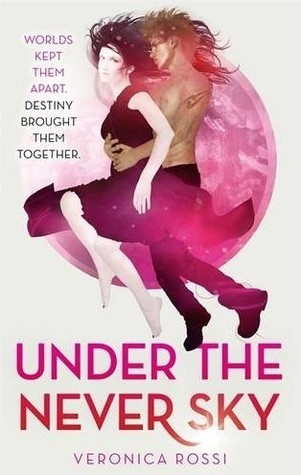
'Under the Never Sky' | Veronica Rossi

 Under the Never Sky (Under the Never Sky, #1)

This was an enjoyable book, if a short one (compared to what I've been reading lately anyway).

'Under the Never Sky' is about a dystopian future, where humanity has basically been split into two. One half of the human population live inside Pods, where they spend their whole lives inside Realms, basically virtual realities where they can do whatever they want or desire. The other half lives outside, hunting for what food they can find and trying to survive the dangerous Aether storms that threaten to destroy their villages. Aria is from the Pods and has always lived in comfortable ignorance and bliss, where as Perry is an Outsider who has always struggled to survive. Aria suddenly finds herself outside the safety of the Pods and their two worlds are suddenly brought crashing together and they need to depend on each other.

I thought the world this book was set in was really interesting and quite different to other stuff I've read and was rather well thought out. I felt it took a little while to grasp everything that was going on here and to understand everything as some stuff isn't explicitly explained straight away, which makes sense in a way as we are dropped into the action and characters wouldn't just explain everything about their lives for no reason if you know what I mean.

I thought the characters were really well written and thought out as well. Aria starts off as somewhat annoying which makes sense given where she's grown up, and Perry can be harsh as well, but they both grow softer and nicer as the book goes on and they adjust to each other's company and they fall in love. Both main characters grow and develop and change as well which was nice to see. Which I thought was another well written aspect, as it does take it's time to develop and it isn't instantaneous. Roar was a good and amusing character, the perfect joker best friend really. Cinder was an interesting character as well, who I look forward to seeing how he develops and his past is explained in future books. Marron was a good character too.

I thought the overall story was really good and the events were pretty true and realistic for the world. I thought the ending part was a tad rushed though but it'll be interesting to see what happens in future books. I thought the ending, although a bit rushed, was good though and set up the characters in a nice way for the next book... until the very last page though which was just cliched and silly and just obviously so it would have a happier ending.

Overall, I thought this was a good book, well thought out and the characters were good and really interesting, and I'm interested to see what the next book is about.

Saturday, 10 November 2012

'Among Others' | Jo Walton


'Among Others' is the story of a teenage girl from Wales called Morwenna Phelps, or Mori for short. Mori is no ordinary teenager, she and her twin sister Mor are able to see fairies and use magic, like their mother. Except their mother is evil and the twins decide they must stop her at all costs. In their attempt to stop her however, Mor was killed and Mori is left with a crippling injury in her leg that forces her to use a cane. Mori flees Wales to find her father who left when she was a baby, and 'Among Others' tells Moris tale after this, as she's sent to boarding school and attempts to deal with the magic, but also to come to terms with Mor's death.

'Among Others' is an interesting book. It's told from Mori's perspective through diary entries, and I think style really works to tell Mori's story as months pass in the novel and both her daily activities and her thoughts are recorded.

For the most part the book is your average, teenage boarding school story, detailing life at Arlinghurst (the school) and when Mori comes home for the holidays and such, as well as the usual teen dramas that come with it (eg. boys). But woven throughout is magic, and Mori spends a great deal of time wondering about magic and it's effects. Walton uses a different kind of magic system in this book which is really intriguing, whereby there's no magic spells or incantations, and things don't just magically happen, but rather events conspire to make things happen. For example, she might use magic to make a bus come around the corner when she wants it to, but events along the way will make the bus come at that time, if you get what I mean. It's more coincidental magic really. I couldn't decide however if the magic and the fairies that Mori spends so much time talking about would end up being real or not, and if I wanted them to be real or not.

Mori herself is an interesting character, but I just couldn't really get behind her or like her too much. On the one hand she is incredibly independant and strong-willed, and I love her story. But on the other hand, she just seemed really childish to me a lot of the time, but other times would suddenly grow up and be a teenage girl before reverting to her more child-like persona. I mean, she spends a lot of time thinking fairies and the way writes and the things that happen to her made me think of her as being no older than like 12. But then later on she reminds the reader that she's 15 and I just don't quite remember being like that at 15. And there are moments when she is shown to definately be this grown up 15 year old, doing things with boys (or at least thinking about it). Sometimes it was really disconcerting, for example at one point like halfway through the book she was thinking her usual thoughts about magic and stuff, then all of a sudden just off-handedly mentions that she then masturbated while thinking about a boy, and I just read it and was like, "wtf?!". It was just jarring.

But on the other hand, over the course of the book, Mori does grow up. This book is another one of those books which is essentially a 'coming of age' tale. And I feel that the more adult Mori seems to be more present in the latter half of the book, which I suppose reflects her personal journey which sees her growing up and accepting Mor's death.

I found it quite hard to get really into the book however, or feel gripped to know what was going to happen next, and I do think that some threads were kinda left abandoned at the end (although some were really quite unimportant overall), and that the ending part was really rushed. I mean, I can see how we're supposed to think that Mori just carried on living and that some stuff would carry on after the books ended, but it all just seemed a bit rushed and over quickly and in a bit of a cliched manner.

Mori also spends a lot of time reading science fiction books and talking about them, and while that was nice and interesting, I felt Walton made a lot of references to science fiction texts and stuff, and it sometimes felt that the reader might be missing out on something if they hadn't read all or most of the hundreds of books mentioned, although it would make a good list of books for anyone wanting to read more science fiction/fantasy! I did like the irony that Mori hates fantasy books, and yet that's what her story is basically.

Okay, I seem to have rambled a lot!

Overall, I thought the book was interesting, and got more interesting as it went along, but I felt that there was just something missing from it and Mori could be quite jarring personality wise at times. I felt that the main plotline got quite buried, and it was only at the end really that I was able to go "Oh, it was about her growing up and dealing with Mor's death" which I feel should maybe have been more obvious earlier on, but looking back I can see hints of it earlier on. Overall, a good book, but not great.

Tuesday, 6 November 2012

'The Twelve' | Justin Cronin


'The Twelve' is the sequel to 'The Passage' but Justin Cronin, and the second in his 'Passage' trilogy.

The basic premise of the trilogy is that the American government discovered a strange virus in Bolivia in our not too distant future, and they government try and use this virus to create super soldiers out of 12 death row inmates, but instead create vampiric like creatures, Virals, who ultimately escape and take over the American continent. Near 100 years later a greatly reduced human population still exists, trying to survive against these creatures and save humanity, as seen by protagonist characters Peter, Alicia, Michael etc. But then there's Amy, who was a 6 year old girl when the outbreak first occurred, and was infected by the government with the virus shortly beforehand, but it changed her in a different way to the others, in the 100 year gap she has barely aged, but has all the abilities of the other Virals but without the blood thirst or other weaknesses. This is all covered in the first book.

'The Twelve' follows the same split narrative as 'The Passage'. The first third or so of the book goes back to shortly after the Virals escaped and started to spread, but focuses on a new set of characters in a new situation. There's Kittridge, aka Last Stand in Denver, who initially holed up in a high rise in Denver sniping Virals but then was forced to flee. Then there's Danny, a somewhat ... 'simple' man who drove a school bus and who rescues teenagers April and Timothy. They later met other survivors in Pastor Don, Dolores etc. Together they try and escape the Quarantined south. Also introduced here is government official called Guilder, who discovers that Grey (who had been a janitor at the facility where the original Virals were created) survived the massacre there and tries to find him. But the virals are spreading fast...

Following this, the story jumps forward to 97 A.V. to rejoin Peter and co., 5 years after their exploits in 'The Passage'. These 5 years has seen the characters spread out and separate, and they've all changed and grown a bit in these five years. Peter has joined the Expeditionary and along with Alicia is still trying to hunt the Twelve (the original Virals, and if they die each of the Virals of their 'bloodline' will die as well). Considering the last book with these characters focused on them exploring their environment and trying to find a better home, this time around they are all trying to move on from the events of the last book, with the hope that they can track and kill The Twelve.

Having said that the characters have grown in the last 5 years, they've mostly developed through grief at the Roswell Massacre, which was heartbreakingly revealed in the last lines of 'The Passage' without much detail, but the detail of which (along with who out of our main characters died) is finally revealed in this book. The characters have been grieving, and although they have changed, there is a sense that theyve been in a kind of limbo since then, finding a new path and sticking with it. And all of a sudden at the beginning of this book, for various reasons, the characters are forced to move on and progress, and slowly head towards dealing with a new threat.

I enjoyed the story, I thought it was intriguing and it was nice to see different sides to the story, both in the 'present' type setting and the future, and that the stories told in this book weren't exactly the same as in the Passage just slightly changed. They were very different stories presented this time around which was good to see. It was also nice to see more of the future America, to see more of what happened then rather than just the small snapshot from 'the Passage'.

On the whole though, I think I preferred the 'present' storylines. They were very different to before. In the first book in the present, we mostly dealt with the major characters related to the virus, but this time around we deal with a bunch of "average joes" so to speak, whose lives are suddenly changed and they have to flee. I found their stories incredibly interesting and gripping and I couldn't wait to see what would happen next. The 'future' storylines, while still interesting slowly kind of lost my keen interest over time. It was interesting to see this new world, but I felt the story jumped around too much and it was kind of hard to get my bearings. Just as I started to get used to one character and their environment it would change to someone else and something would change there. It was a little confusing at times. Also, I felt that although you could kind of tell what the whole story was building to, I didn't really feel on the whole that it was something I really wanted to see happen and there didn't seem to be any real sense of urgency or danger like I felt in 'The Passage' or the first part of this book, and so it kinda felt like something was lacking for the most part. Having said that, it was still very enjoyable and interesting and I loved reading about it.

I also felt that some of the technical stuff to do with the Virals (and Amy and Alicia etc.) didn't really get explained, and sometimes things would happen or change with them and it just wasn't really clear why this happened other than for story purposes, and while the whole 'the characters wouldn't know or figure it out so I won't/can't explain it' is kinda nice and realistic, it did just feel like Cronin and had decided it was a nice story tool for this happen or for this character to have gained this ability etc. and there was just no explanation for it. SPOILERS: for example, Amy undergoes a bit of a change, where she seems to have extreme period cramps for awhile, then suddenly turns into a woman rather than a being this immortal child/teenager (which I didnt like happening, as I liked the idea of Amy being this immortal child until the end of the trilogy at least) and then at the end of the book suddenly turns into a Viral through force of will (which I didn't like happening either). Lila's abilities to control the Virals are never really explained to my satisfaction. Neither is Carter's apparent ability to create an experience a sort of 'alternate world', for example when Amy visits him he looks normal and she sees places from his human past - how he does this is never really explained. These are examples of things where I just didnt really think things were fully explained and it just bothered me a bit. END SPOILERS

Overall, I enjoyed the book and I am eager for the next book in the series to be released, which will probably deal with finding and killing Zero. I felt the storyline was interesting and exciting, but that some things just weren't explained enough for my satisfaction and sometimes the POV shifts were a little disconcerting. Overall, a great book but not quite as good as 'The Passage' I think. Bring on Book 3!

Wednesday, 31 October 2012

'The Blinding Knife' (Lightbringer #2) | Brent Weeks


This book was a lot better than 'The Black Prism' in my opinion, and everything that I think the first book should've been. Also, how pretty is that cover! <3

In 'The Blinding Knife', the story picks up almost immediately on from the previous book in the aftermath of the battle of Garriston. The Prism, Gavin Guile, has to find a new home for the Tyrean refugees, while at the same time trying to cope with the fact that he has lost Blue and is therefore dying now, rather than in 5 years as was expected. In the mean time, he sends Kip to train and try enter the elite Blackguard to toughen him up, and Liv tries to adjust to life in the Colour Prince's army.

In the first book, I felt that not a lot happened and the characters were kind of jarring and unrealistic. In this book however that it completley different. First of all, a lot happens. There's still some of the political intrigue from the first book, but there's a lot more drama and suspense and mystery to keep you guessing and hooked throughout.

The characters felt better and more developed as well, predominantly Kip. In 'The Black Prism' I thought Kip was a little... bipolar, in that sometimes he was quite smarmy and witty and other times just moaned on and on about how pathetic he was. While his overall personality hasn't changed, I felt that he was more consistent in his personality, and no longer moaned on and on about his patheticness - he felt more real. And over the course of the book he obviously grew and developed as a person which was great to see, and you can see him growing into more of a hero.

There were also some nice additions to the cast of characters, firstly in Teia, Kip's training partner in the Blackguard training class. There was also Cruxer, a prodigy and good hearted boy also in the training camp. We also saw a lot more of Andross Guile, Gavin's father, who was a delightfully cruel antagonist character that was lovely to see.

Overall, I felt that the book was a lot better, as Weeks has managed to settle in to the story and characters a lot more. This book was a lot more gripping than the first one, and left me greatly intrigued into what will happen in the next book. It also included a useful glossary and appendix explaining various terms and aspects of this world that was not in the first book and I felt was incredibly useful to help readers understand certain aspects of the world, particularly the magic side, without having to stop the main story in order to describe it all. Overall, a great improvement.

'The Black Prism' (Lightbringer #1) | Brent Weeks


So, I loved Brent Weeks' Night Angel trilogy, so when I heard about this book I knew I had to read it eventually (eventually turned out to be a few years later). Honestly, I didn't enjoy this book as much as I did the Night Angel trilogy, but it was enjoyable.

The book tells the story of Kip, an overweight teenager from a village called Rekton which is shortly massacred by the ruler of the region, but Kip manages to escape by drafting (essentially - magic) and swears revenge. It also tells the story of Gavin Guile, the Prism (essentially Emperor, although most of the roles political power has been taken away long ago). Gavin is charismatic and charming, but harbours a secret and his path leads him to finding Kip, his bastard son (no spoilers - that's revealed at the end of chapter 2).

It's a fantasy story, and the main form of magic in this book is through "drafting", whereby a Drafter (magician basically) can "draw" colours to make an assortment of tools and weapons out of luxin to allow them to accomplish a wide variety of feats. Most drafters can only draw one or two, or sometimes three colours, and all drafters need to be able to see that colour to draft it. It takes a toll on them though and most drafters die by the time they're 40/50. All drafters, apart from the Prism though. A Prism is born once a generation and can draft every colour and there is no limit to his abilities apart from his own strength, but only manage to rule as Prism for a multiple of 7 years. Gavin for example has ruled for 16 years, meaning he has 5 years to go, as most don't make it past 14 years before dying.

One thing I found complicated about the book was the magic system, and this is why I just explained it a bit. It wasn't really clear early on what luxin was or how drafting worked and most of it I had to work out for myself before a decent explanation was provided (if it was - I'm stiill not entirely sure what luxin is. It's an interesting system though and it was nice to read about a system of magic so different to what you find in most fantasy books.

On to the characters - I really liked Gavin, I thought he was very charismatic and a charmer, and I can see why most women in the book seem to be in love with him. But at the same time he's incredibly mysterious and intelligent, and I spent a lot of the book wondering about him and his past and what would happen as bits and pieces were revealed. Kip on the other hand, I didn't like as much. Kip seems to have a bit of split personality whereby he spends half the book whining and just thinking about how fat and useless and pathetic he is, but then every now and then he turns into someone really witty and self-assured and stuff before suddenly reverting to his pathetic self, and it was just a bit jarring. I don't know if it was just Weeks' attempt at (and struggling at) writing a character who isn't the typical protagonist or if he was trying to hint at hidden layers of Kip or something but... yeah. Kip just didn't really ring through with me, he was just too jarring.

The story itself was good and intriguing, and hints that the future books in this trilogy will get even bigger and more exciting. For this book though, I felt it spent a lot of time establishing the world and the characters and their backgrounds that nothing overly exciting happened in the first half of the book and it got a bit more exciting towards the end when there was a big battle. It was mostly politics and set up before then. Not that that's necessarily a bad thing, as Weeks has obviously thoroughly thought out the world and the characters and what happened to them in the past and how this affects them now and what every person wants and is like and etc. etc. etc. Basically, he's spent a long time thinking this through and it shows, but explaining all this to the reader does seem to take up a lot of time and it as a result I found the book to be a bit of a slog at first. I am looking foward to the next book in the series though. One plot point I found most interesting, and yet most confusing to be honest, was the fact that Gavin is actually his brother Dazen and is pretending to be Gavin and is keeping the real Gavin a secret prisoner. It was a very interesting concept and made me think a lot about how it all worked and what would happen in the future. It did get a bit confusing as Dazen obviously refers to himself as Gavin most of the time, and Gavin thinks of himself as Dazen and sorting that kind of stuff out about which brother they actually mean sometimes got confusing, but it kinda works because I guess it would be confusing for 'Gavin' as well. Kip being Gavin's bastard was quite obvious so I'm glad that was revealed like immediately, and his drafting gets hugely stronger as the book goes on which makes me suspect he might be the next Prism but we'll see in future books I guess. The knife at the end of the book... I have thoughts about what will happen with that but we'll see... it's intriguing to say the least.

Overall, I enjoyed this book. I still think I enjoyed the Night Angel trilogy more but this book is still good and Weeks' writing style has definately improved since then.

'Blood of the Earth' | David A. Wells


'Blood of the Earth' is the fourth book in Wells series, continuing the tale of Alexander in his battle against Phane and his netherworld forces, and it's this latter that mostly consumes this novel.

This book begins in the aftermath of the battle that took place at the end of 'Mindbender', and in the opening pages the group is attacked by three menacing and sinister netherworld beings who set the stage really for this book and Alexander's quest for the 'Blood of the Earth' - yet another item of amazing power that Alexander has to travel across the Seven Isles to procure and is the namesake for this book (can you tell I'm finding this rinse and repeat formula repeatitive?).

Having said that I find that repeative though, this book doesn't contain as many predictable surprises as in the early 2 books, and there were some genuinely shocking twists in this book which was a relief really. The stage was set for some interesting developments to come in later books as well which I'll look forward to reading when the next books are published. For example, SPOILERS Isabel's heavy taint by the netherworld forces and what this might cause her to do or what she or Alexander might do to prevent it (especially in the light of Rentu's visions), the destruction of the Mindbender sword which I somehow doubt will be a permanent thing - I imagine somehow Kelvin or Alexander will be able to repair it or fashion it into a new item, Alexander's budding friendship with Anja and Bragador, Abigail's friendship with Ixabrax, the progression of Lucky and Kelvin's magics, the return of Jataan - all hints in the concluding chapters of the book indicate to me that we may experience a bit of a time jump or time rush (with the ideas of bedding in for winter, and needing injuries to heal etc.) which could be interesting to see how this affects things... END SPOILERS

Overall, I found this book to be good and interesting, with more surprising twists and turns than before and some interesting plot developments, but overall I found the plot to be a tad fragmented, as instead of a clear plan of what characters were doing, it seemed to keep starting and stopping and changing and so on... It didn't really seem to flow well. Overall though, a good book.


'Mindbender' | David A. Wells

 Mindbender


Okay, so before I get stuck into the review for this, a little warning: I will refer to things that happened in the previous books, including plot points, because if you're wondering if you should read this book you should definately read or have read them first and not gripe at me about plot points from that. I will hide plot points/revelations from this book behind spoiler text though so don't worry.

So, in 'Mindbender', we follow on from the previous book almost immediately again, with Alexander and his friends having just arrived on Ithilian through the Reishi Gate, trying to create an alliance with the Island, whilst Isabel and Abigail are still held prisoner (albeit comfortable prisoners) in the Reishi Fortress, trying to free themselves and also win them over to Alexander's cause.

I liked the switch up and change in the narrative in this book, with the action switching frequently between Alexander's group and Isabel and Abigail. Wells improved writing style from 'Sovereign Stone' continued here, although he does continue to repeat the same descriptions A LOT for certain characters - not so much (that I noticed) for people like Anatoly, but a new character called Wren is almost continually referred to as "waifish" which is a tad annoying.

Character wise, there were some nice new additions to the cast: Conner Ithilian, who was met briefly at the end of the last book, appears more here and is quite a nice addition to the group. Jataan and Boaberous also appear throughout the book this time having joined Alexander's group at the end of 'Sovereign Stone' - SPOILERS the only thing that slightly bothers me however is that they are both just hugely formidable warriors, particularly Jataan, and so battles from now on are a lot easier and there isn't as much an element of danger as there was before and characters like Anatoly who was a major warrior before and guardian of Alexander kind of becomes superfluous now. END SPOILERS

Plot wise, I enjoyed the story of this book. It had an obvious purpose, even if it was probably a bit drawn out in the overall scheme of the series. It was quite suspensful and chilling (I would NOT like to encounter the revenants for a start!), and I found there weren't as many blindingly obvious plot revelations in this book as there were in previous books - there were one or two that I half-predicted shortly before they came to pass but nothing that I predicted a book or two back. SPOILERS I had a feeling one of the girls would become a wyvern rider during their stay in the fortress, particularly after the focus on the wyverns so it wasn't too surprising when Abigail became one. I did not predict Alexander finding the sword Mindbender (mostly because, you know, it hadn't been mentioned at all before this). I did think that Mindbender was a bit of a deus ex machina again. In each book so far, Alexander has found an all-powerful ancient artefact taht grants him amazing power, and Mindbender is another example - by touching the sword he can predict what the enemy will do in battle and so counter their moves and he can create giant illusions - it just seems a bit much to me and, yeah, like I said, a bit of a deus ex machina. I only wonder now if Alexander will continue to gain an amazing ancient artefact of huge power in each book because if he does it's gonna get a bit ridiculous. Also - at the end they've basically invented a kind of a-bomb-without-the-radiation-probably type weapon... hmm... END SPOILERS

Overall though, I enjoyed the book a lot again, probably more than I did 'Sovereign Stone' and I cannot wait to read the next book in the series.

'Sovereign Stone' | David A. Wells


Okay, so a little warning: I will refer to things that happened in the first book, including plot points, because if you're wondering if you should read this book you should definately read 'Thinblade' first and not gripe at me about plot points from that. I will hide plot points from this book behind spoiler text though so don't worry.

Okay, so... 'Sovereign Stone' is the second in Wells' Seven Isles series, and follows pretty much immediately on from 'Thinblade' - with Alexander and his group inside the Blackstone Keep after Alexander retrieved the Thinblade from the bloodvault within at the end of the last book, with Jataan P'Tal's forces camped outside in wait. In this book, Alexander and his friends must go to retrieve the Sovereign Stone, an ancient artefact that Prince Phane desperately wants (MILD SPOILER - kinda), as it will allow him to send armies across the isles through special gates to surprise and devastate his enemies. It would also teach Phane the secret of Wizard's Dust - the powerful substance that allows wizards and mages to gain their power. END SPOILER

I must say, I enjoyed this book more than I did the first book. In my review for 'Thinblade', I mentioned that I found the writing to be quite annoying and simple. Halfway through 'Thinblade' though that stopped being so much of an issue, and the same can be said here. I found Wells' writing style to be improved in this book, as he obviously must have hit his stride by this point. One thing I have to say carried on though, to my annoyance a bit, was that Wells would constantly re-use certain descriptions for characters. I can understand reinforcing an idea, but when Anatoly is referred to as the "big man-at-arms" or Lucky as a "rotund alchemist" for example every like 15 pages at least, it does get tedious.

The characters developed somewhat from the previous book, but were still the same, basic and somewhat flat people they were then, although I cannot criticise Wells too much for this as it cannot be easy to hugely change a character to make them less flat without, you know, huge dramatic changes and you can't really do that to all of them.

Plot discussion (TOTAL SPOILERS): The plot was okay, if slightly boring. As they were just travelling around for the most part running from Jataan.

I thought Alexander and Isabel's wedding halfway through the book was ridiculously cheesy and fast (I mean, they can only have known each other for a couple of months at most), especially since even less time had been spent developing their love/relationship than in the last book. I found ironic and stupid (even if none of the characters did) that it occurred right after the Fairy Queen was criticising the fact that they hadn't devoted their lives to each other whilst they were trying to win their allegiance, and so they decide to get married on the spur of the moment, and yet no one thinks this is a bit weird and stuff and blergh. Yeah, just... strange.

Chloe was an... interesting addition to the group. Considering all the warnings about the Fairy Queen's price for her loyalty etc. - with Chloe and Alexander 'bonding' and being in love (as well as Isabel and Alexander) there doesn't seem to be any actual issue - Isabel isn't remotely upset or jealous or anything... which just seems a bit unrealistic to me.

Also, the 'revelation' that Alexander is of the Reishi bloodline was so obvious. I mean, when he and Phane had HUGELY similar physical descriptions (ie. their gold-flecked eyes) within like 20 pages of each other at the beginning of the first book, I immediately called it that they'd be related - well guess what!! So obvious... And it so convieniently handled the problem of Jataan, the uber-soldier who they could never defeat and who was so unhappy serving Phane, as he immediately switched sides (also - I totally called that Jataan would switch sides during book 1 as well).

The Sovereign Stone seems like a bit of a deus ex machina since it allows Alexander to talk and gain knowledge from the previous Reishi sovereigns... END SPOILERS

Also what I wanted to talk about was Alexander and his character - I'd mentioned in my review for 'Thinblade' that Alexander wasn't really the typical hero in these types of stories. There never really seems any doubt that he'll succeed in anything he tries, and he seems to be an amazing strategist etc. and he is never corrected or has to be helped or guided in anything. MILD SPOILERS What worries me most though, is that he doesn't seem to have any problem killing, particularly when it comes to nobles and such. I mean, killing on the battlefield is one thing, but when the group passes through Kai'Gorn - he almost nonchalantly decapitates the (admittedly corrupt) ruler there and tosses his head into a crowd. He then later nonchalantly kills the regent of Southport, and he does both because they're corrupt and serve Phane. He justifies this as him dispensing justice and upholding the Old Law, but at the same time it just seems ruthless and bloodthirsty, and part of me hopes that it might be prelude to a subplot about him being a bit tyrannical, although since no one has really had an issue yet I doubt it. Maybe I'm just too soft and idealistic, but it just doesn't sit right with me. END SPOILERS

Overall, I enjoyed this book more than the first one. I felt the author had hit his stride with his writing style by this point, and the overall storyline is progressing nicely, even if it was a tad boring this time. The story for the next book is set up nicely and looks interesting. Some plot revelations were a bit obvious though and there were some things character and plot wise that just seemed a bit off and flat or strange. Overall though, a good book (and Im sorry that a significant part of my review is hidden by spoilers!

'Thinblade' | David A. Wells


When I first started this book, I wasn't overwhelmed by it. I just didn't find myself gripped by the action presented in the first chapter, and I found the writing style somewhat annoying. The author would often just state facts about a person's character, and then re-state it again and again like 20 pages later or something when it came up again, rather than being more subtle about it or whatever like I kind of expected from a book. And the descriptions seemed rather matter of fact and seemed to lack real depth.

After about halfway through the book however, these issues stopped being issues however and the author seemed to settle into the narrative and it seemed to flow more naturally.

The story itself is essentially your basic fantasy tale - the main character lives in a world of magic, and suddenly discovers he has been chosen and is destined to save the world from the evil villian and goes on a quest to do so. Alexander is the Marked One, predestined to stop the evil Prince Phane who has slumbered magically for 2000 years, waiting for his chance to take over the world.

The characters seemed to lack a bit of depth, they didn't really seem flawed in any way. Alexander just accepted his destiny without any struggle, as did his friends and family and there's no real hesitation or anguish about it, and they all think really logically and strategically about everything. Maybe I'm too used to the protagonist being the cocky or quick tempered guy who has to settle into his role, rather than Alexander who just seems to slot into it straight away. Phane as a villian is quite flat as well, but with him I don't mind it as much - he obviously just wants to rule the world and is quite cruel, but it seems to add something to his evilness that I don't mind so much with him.

Another thing that irked me about the characters, is Alexander's love interest Isabel. It was obvious (as it usually is to be fair) as soon as we met her that she was going to be his love interest. SPOILER [But it just seemed to progress insanely quickly and without much exploration or development. I mean yes, they both seem to be attracted to each other as soon as they meet, but within like 20 pages of meeting Isabel, Alexander declares that he is in love with her, and before we are even halfway through the book (considering we met Isabel about 1/4 of the way through-ish?) he proposes to her and she accepts.END SPOILER Little time seems to be spent to developing their relationship, apart from the fact they are both obviously attracted to each other, and there doesn't seem to be any consideration for how this might affect things, any problems with it or the fact their love will probably be putting her in even more danger. There's no real hint of this in the book.

SPOILER Also, the plot point of the fact that Alexander is King of Ruatha etc. and that's why his bloodline was cursed and destined to be the ones to stop Phane was so blindingly obvious. Also, Alexander goes from minor noble/ranch hand to King without little hesitation or problems, which just seems flawed. END SPOILER

Okay, so I've ranted a lot about how flat the characters are and stuff, but overall I did enjoy the book. About halfway through the book, apart from the odd incredibly cheesy thing I stopped being bothered by thoughts of how I was annoyed by the writing style etc. I will be reading the next book in the series (I hate leaving stories unfinished unless it's REALLY BAD), and I hope that the author settles into his writing style more and progresses. Overall, an enjoyable book, but not the best book ever.

Friday, 31 August 2012

The Lost Symbol book review


I loved The Da Vinci Code and Angels and Demons, and I enjoyed Deception Point and Digital Fortress. But the Lost Symbol just didn't really click for me. I dunno what it was, but something was just lacking.

In this book, Robert Langdon just didn't really feel like Langdon to me. He was always dismissing possibilities and refusing to speculate stuff, and he just didn't seem to be the same Langdon from DVC and A&D. Admittedly, it has been several years since I read those 2 books, but in the Lost Symbol I was constantly getting annoyed by him and his attitude.

I also felt that the mystery and plot this time around wasn't quite up to scratch. I guessed a fair bit of the major plot a long way ahead of time, and the mini plot twists were all quite easy to guess how they would be resolved (at least in my opinion). And while I understood some of why what the main bad guy (Mal'akh) was up to was bad, I felt it was greatly over-exaggerated to be a bigger deal. The main baddie was introduced within about the first 5 chapters or something, which I felt detracted a bit from the overall mystery and plot as I liked the feeling in DVC and A&D that there was a greater mastermind manipulating the events behind the villian/thug who Langdon kept running into, and I just hoped from the moment Mal'akh was introduced that this would be the case too.

Also, I just didn't feel that the plot was overly intriguing or gripping, and I don't know whether I just wasn't particularly fascinated by the Mason-plot or whether it was because I felt the book was not as good as the previous 2 Langdon ones, or maybe it was because it was set in America as opposed to Rome and Paris, cities of greater intrigue and love for me.

Overall, for a Langdon book by Dan Brown, I was fairly disappointed. It was a decent book, but it just did not live up to my expectations as a fan of the Da Vinci Code and Angels and Demons. It might have been a bit better if Robert Langdon hadn't been the protagonist but obviously would have required a lot more in terms of character set up and development. It may have been better if it wasn't a Dan Brown book. Basically, it was a good book, but not great.

Queen of the Damned book review


The Queen of the Damned is the 3rd in Anne Rice's Vampire Chronicles series. Having read both 'Interview with the Vampire' and 'The Vampire Lestat', i was looking forward to reading this book. Overall, I enjoyed the Queen of the Damned, and anyone who has read the previous two books probably will as well, but found it was a little disappointing and underwhelming. It was still very enjoyable however, but think I preferred listening to the stories of Louis and Lestat in 'Interview' and 'Lestat' more personally.

Mild Spoiler warning! - I'll talk vaguely about what happens in the book from here until the last paragraph, but not reveal directly what happens, so please skip to the last paragraph if you don't want to know anything.

This book follows immediately on from 'Lestat', where Lestat has awakened the 6,000 year old mother of all vampires, Akasha (the titular Queen of the Damned), with his rock music and she is coming to destroy them all. The book actually starts with 7 separate narratives told by different characters, revealing their experiences in the nights leading up to where 'Lestat' left off, which was initially annoying as I wanted to read about what happened to Lestat, but was actually quite interesting as it set the scene and introduced me to the various mysteries surrounding the vampire community and other important characters. Then the narrative rejoins Lestat and other important characters (both from previous books and the first part of this book) to show what happens after Akasha has been reawakened.

Overall, the book was really good and interesting, and although it lacks the centuries spanning tales that I think made 'Interview' and 'Lestat' so gripping as it is all set in the modern day, it does contain a long sojourn where a character reveals what happened 6,000 years ago which was interesting.

From the blurb on this book and the impression I had after 'Lestat', I was expecting there to be a lot more action and drama in this book, particularly at its conclusion. While there were action scenes spread throughout the book, it was not as action-orientated as I was expecting, and the final confrontation with Akasha largely began with the main characters all sat around table talking and debating. Maybe this is just Anne Rice's style however, as to be fair I don't remember huge action scenes (although there are some) in the previous two books.

Mild spoiler warning over!

Overall, I enjoyed the Queen of the Damned, and it was an enjoyable book in this series. However, I personally enjoyed 'Interview' and 'Lestat' more, as I think I preferred following the tales of Louis and Lestat from their beginnings over the centuries, as I think I found that more intriguing. It's still a good book though, and anyone who has read the previous two books will enjoy this as well.

Thursday, 26 July 2012

'The Passage' | Justin Cronin


So I bought this book about 2 years ago, and have been meaning to read it since I got it, however life (and University) kinda got in the way and so I've only just gotten around to reading it really. And I loved it.
 

'The Passage' tells the story of a young girl called Amy Harper Bellafonte. In 2018, the military was experimenting with a virus they discovered, trying to create powerful super soldiers using death row inmates... and eventually 6 year old Amy. However, one night, an (inevitable really) catastrophe strikes - the 12 infected experiments escape, resulting in the fast and widespread infection of the US and the end of civilization as we know it. Eventually, what remains of humanity, struggling to survive in a world where to be out at night without the protection of light means certain death at the hands of the virals, must learn to fight if they want to survive for much longer.

Cronin has created an amazing epic tale. It's incredibly detailed and well thought out, making it believable and chilling. The characters are so well rounded and thought out, every aspect of their past thought out to decide how they would react to certain situations and what their motivations are. Cronin's narrative begins around 2012 then moves on slowly to 2018, and the events that lead up to the outbreak of the virus, before moving on decades into a fully realised and thought out future. The level of detail and planning that has gone into this is amazing.

The story itself starts off as your kind of standard end-of-the-world/virus outbreak story. But that just kind of occupies that first quarter of the book, and the rest of it focuses on the people in the future who have been born into this world of fear and darkness, who are trying to find a way to survive in this world as it slowly begins to crumble around them.

The main narrative is fairly linear and floats between different characters, which is nice as it gives an insight into the motivations and minds of a wide variety of characters. It also briefly segways several times into the past of the characters to reveal pertinent moments from their past, which either directly affect the main narrative or just reveal more about the person itself. It's also told in an interesting way, mostly from a 3rd person perspective following each important character, but occasionally punctuated by extracts from diaries and emails, adding to the sense of realism, as if someone was reading this and trying to discover what happened in a future beyond what occurs in the books.

I have to say, most of the story isn't quite what I was expecting when I read the blurb of the book, but it was probably actually better than I imagined once I started to read it. The book was gripping, particularly after the halfway point. I actually read half of the book last night, staying up late to finish it. Overall, an amazing book! I can't wait for the second one which I believe is due out in October!

Monday, 23 July 2012

The Dark Knight Rises review (spoiler free)


So, on Friday the Dark Knight Rises was released. The final film in a trilogy from Christopher Nolan re-imagining the origins of Batman and his rise to the hero of Gotham City, with all the troubles along the way. Batman Begins was a good film, enjoyable. The Dark Knight was amazing, with extra emphasis as a result of the death of Heath Ledger (who portrayed the Joker) shortly before the film was released. I went to see The Dark Knight Rises on Saturday morning, and I have no qualms in saying it is easily as amazing as The Dark Knight if not better. I'll do my best to stay away from any spoilers in the film over the course of this review, but will refer to stuff that happened in the previous films (don't hate me, they've been out for years, you've had PLENTY of time to watch em).

Okay, so for those unaware, a little background on the film. It's set 8 years after The Dark Knight, and following on from the end of that, Harvey Dent's descent into being Two-Face has still been hidden and he is still regarded as a hero. Batman is still regarded as a villian by most of Gotham and Bruce Wayne still mourns the death of Rachel Dawes. He soon encounters talented Cat burglar Selina Kyle and is instantly intrigued by her. Meanwhile, Gotham begins to be terrorized by a new threat in the form of a mysterious masked man known as Bane, who seems to pose a big threat to Gotham, and one that Bruce Wayne as Batman will have to face.

The film is great. It kinda seems to take awhile to get into the heart of the action, but it's good actually as it subtlely builds up plot and character points that become important later on in the story and slowly builds up the threat of Bane and leaves you wondering about the overall plan and scheme. I did feel that there wasn't as much Batman action in this film as in the previous films, but this didn't feel like a major negative thing and there was plenty of action and drama in the film already.

Bane as a villian was great. I know people who watched the leaked prologue and trailers etc. complained that they found it difficult to understand Bane, but in the finished film I wouldn't say that this was a problem at all, the filmmakers obviously tweaked the audio to make sure Tom Hardy would be understand through the mask. Bane was a good, intimidating villian with a clear master plan. Bane is known in the comic books for testing Batman physically and mentally, for being a great strategist and that does come across in the film. It was a very nice change from the Bane from Batman & Robin where he was a mindless goon anyway.

John Blake, played by Joseph Gordon-Levitt, was a nice addition to the cast as a Gotham Cop, being a main investigator and assistant-hero whilst Gary Oldman's Gordon settled into his commisionner role. He was very multi-faceted and a good hero character with some interesting twists later on in the film.

Anne Hathaway's Selina Kyle/Catwoman was fiesty and seductive and interesting, and found the suitable Catwoman balance between hero and villian that she sways between in the comics.

Overall, the film was really good. It had great music (once again) and the cast was superb with well-rounded characters, both the veterans of the series like Alfred and Gordon, who have clearly continued to develop and have changed between this film and the previous one, and new additions to the series like Blake and Catwoman. There are a multitude of twists and turns and gripping moments that kept me hooked throughout the film, although if you've heard some of the rumours about certain characters one or two of the twists might not be so surprising. The ending of the film was a satisfying conclusion to the series as a whole, wrapping up this trilogy as well giving a suggestion of hope for what will happen for Gotham next, even if there are no more films.

Overall, an excellent film. Go see it!


Thursday, 12 July 2012

What I Learned from University, pt. 3 - The End

So, here it is. The final part in my little series contemplating and ranting about the various things I've learned during my time here at the University of York. I had thought about writing a few other entries in this little series, but 1) I'm too lazy and 2) I think that might be a little OTT. So I'll just put a bit about the stuff I thought about writing into this one (big-ish) entry.

One thing I learned at Uni is that I wish I'd gotten a little more involved. In societies and things. I mean sure, I went to a few society nights out and stuff and took part in Aerobics sometimes. I helped out a little and took part in RAG events. But I still don't think I got involved enough. Before I went to Uni and in my first weeks, I had all these plans to go to loads of different societies - things like zumba, photography, creative writing, join the Orchestra or a wind/ceilidh band - maybe take up a new language (like Japanese which I'm so eager to learn) or do something a bit different and exciting. But in the end, I didn't. Probably because I was too afraid to go on my own. If one of the people on my floor had said they were going to go I probably would've, but no one did and I chickened out. But looking back now, I really wish I had gone.

Another reason I didn't really get involved in societies too much though, is because I had a part-time job. Before I went to University, I was already working part-time in a pub back home in Newcastle, and through that I knew the manager (at the time) in a pub here in York, and so as soon as I learned I was definately going to York I asked her for a job and got one. So I had that from the beginning. During my 6th form I sometimes had issues balancing my job and my school work and responsibilities, and I was aware that I didn't want that to happen at Uni, so I was careful not to take on too much. Uni work took priority, and then my job, and so after that I was wary of getting too involved in societies that would consume too much of my time. Looking part, I could have gotten involved, and I do regret that I thought I couldn't handle it.

At the same time, not having too much societal commitment and having my job instead has been great. I mean, for starters, money at uni has gotten increasingly tight, and so my job has let me do little things like eat food and pay bills which is always a plus. But at the same time, I've made so many amazing friends through work and had so many amazing nights out and done great things and I don't regret a second of that. I love all the people I've worked with, and now that I'm finished there and moving back home I know I'm going to miss them all so much. We went out for my Leaving Do a few nights ago, and it was lovely. The perfect night just having fun with everyone and a great way to say goodbye without it being too sad - I'll admit I did cry at the end when I left but I was quite drunk and I blame everyone else for setting me off... ahem ;) But I am going to come back and visit them all a lot, and we've said they'll invite me to stuff and I can stay at one of theirs and there are plans for them to come visit me in Newcastle too.

I've also had loads of fun with my friends that hasn't been restricted by societal commitments. We've had loads of coffee hangouts and nights out and just chilling watching DVDs at one persons house or another. I've particularly had a good time just hanging out and messing around with my housemates, and one in particular who I've lived with for the last 2 years and we kinda lived together (in the same block but different floors) in first year. We've just had a great time and I'm gonna miss them all loads as well.

What else have I learned? I do not travel light, as my parents and housemates will all attest to. I bring a lot with my to uni and I bring as much as humanly possible back and forth with my during the holidays. Far more than I really need to, I'll admit, but I just can't seem to leave stuff behind anywhere - what if I need or want something in particular!? Yeah, I'm terrible at travelling light. Thank god for my parents and their willingness to drive me to and from uni at the beginning and end of every term.

My time management is generally quite rubbish, but if I put my mind to it I can get it under control.

I'm terrible at saving money. As soon as I have an excess of money I spend it on clothes/books/games/DVDs/useless crap. It's something I really need to improve upon. If I had done earlier then I might have actually been able to go on holiday in the last few years or just not worry so much about money.

The best hangover cures are lots of water and greasy food - preferably chips. Chips are a wonderful hangover food cure. Dunno what it is, but greasy food like that always works to cure a hangover. Water is the best thing (and a paracetamol) for hangovers, as you're often mostly dehydrated. A shower works wonders too, and just getting out and getting on with the day and getting some fresh air. Wotsits are also amazing for making you feel better if you feel sick. Tried and tested student cure that I'll swear by to anyone.

I'm not as bad a cook as I think I am. Yes, I'm not great by any means, but I can actually cook edible things. A shock, I know.

I'm actually more religious than I thought I was. Well, to be fair, Uni hasn't really taught me this, it's more family stuff that has happened whilst I've been at uni that's made me realise this, but whatever. At the end of my first term, my great-grandmother died, and I loved her and was really sad, but at the same time, I didn't actually see her that often. But then, about 15 months or so ago, my Nan died. I loved her so much and saw her fairly frequently and she was always asking about me and everything. I was absolutely devastated and I still miss her so much. But I've realised since she's passed that I'm a bit more religious than I thought I was. I had my Holy Communion when I was about 8, and my family went to church in the lead up to that but haven't been since (not counting Christenings and funerals and such) and I never thought of myself as a religious person. I'm not even really sure what my religious views are. Technically I'm a Roman Catholic, but I don't really believe in everything about Catholicism or follow all it's teachings. But I've realised that I do think there is a God or something up 'there', or at least I hope I do. I saw another family on a street near to mine preparing for a funeral this afternoon which reminded me of this, and I subconsciously crossed myself as we went past. I'm not very religious, but I think I do think there is some kind of God and I find myself comforted by praying when I'm upset or worried. I pray that he looks after my Nan and Grandad and other relatives in heaven. I still miss my Nan terribly and wish she was still here to see me graduate, but I know she would be proud of me.

To appreciate my parents. I've always loved them and got on with them, but strangely being away at University has made us closer. I feel I can talk to my parents about anything now really, and we're a lot closer. We've emailed each other every week I'm away at Uni, but they still frequently text me during the week as well, and we have a good laugh whenever I'm home as well. I still text my mum for advice with cooking, house stuff and just general advice. I dunno what I'd do without her. I love my parents, and I appreciate them all the more now for everything they have done for me in the past and continue to do for me.

I'm pretty sure that I've learned a lot more at University than the stuff listed here. University has taught me so much about myself and the world, and I've loved every second of it. I'm going to cherish all my memories of my time here. I know I've made so many lifelong friends (or good friends at least - I hope they're lifelong ones!). As I graduate tomorrow, I'm reminded of the following Baz Luhrmann song, and I'll end this with that song.

Wednesday, 4 July 2012

FFVII PC Re-release announcement

So, if you like gaming at all, you've probably heard of a little game called Final Fantasy VII. You have? Told you. If you haven't... I honestly have no words.

FFVII was released by Squaresoft (now known as Square-Enix) way back in 1997 on the PS1, and was shortly afterwards ported to the PC. FFVII is a huge, fanboy game. There are people who rave about how it's the "BEST GAME EVAR" and go on and on and on in angry rants at anyone who dares to say anything slightly derogatory about any aspect of the game. It was huge. It's probably one of the reasons Square's Final Fantasy series is as big as it is. It even has it own mini-series of games  and a movie (the Compilation of FFVII as it's referred to). And today, Square has finally announced it's releasing it again.

But not in the way most fans thought/wanted.

It's re-releasing for the PC via their online store. The game has exactly the same graphics, gameplay etc. as it did in 1997. The only difference with this re-release is that the software's been slightly modified so that it'll run smoother on modern computers. It also will contain a variety of new bonus online features. It will have 36 'achievements' to be unlocked that you can compare with your friends, have a Cloud save feature (I'm already dreading all the puns that will arise, since the main character in the game is also called Cloud... >.>) and a 'Character Booster' feature, where you'll be able to "increase the HP, MP and Gil levels to their maximum, all with the simple click of a button, leaving you to enjoy your adventure" (source: http://finalfantasyviipc.com/en). This last feature is obviously to reduce the difficulty for novices of the series, but Square has been quite vague about how this feature will work. Will it increase the permanent HP etc. levels, or just fully heal your party? And what exactly will this cost? Will it be an in-game cost or will you have to spend your own, actual hard-earned pennies to do so? (the latter seems more likely to me)

While this kind of simple PC re-release has been hinted at before, it's kind of surprising that this is what SE decided to do with their 'flagship'  game of sorts, and yet, not surprising at all (give me a minute here, I'll get round to that).

On the one hand, it's kind of surprising. For years, fanboys of FFVII have been crying out for a remake of the game with HD graphics, kind of like the ones the PS3 tech demo (just search YouTube, you'll find it) or any other modern game. And a lot of people in the gaming community suspect/know that Square have probably been working on such a remake for a few years already. Square know the fans want an actual HD remake, so just re-releasing the old game is a slight surprise. I thought if they were going to re-release FFVII at all, it would be the HD remake, and it suggests to me that if they holding back on said remake, it'll be a while before they do release it. I mean, why release the old version of the game, just to release the remake within a couple of years or something?

But at the same time, I'm not surprised at all. For as long as fans have cried out for a remake, I've always said Square won't do it. At least, not yet. Square know that if they do make and release a HD remake of the game with modern graphics etc., then all the FFVII fanboys will buy it and they'll make loads of money. It's the ace up Square's sleeve essentially. If they release, they'll make loads of money and be set. So why release it when the company is still doing well financially and making games that are selling millions of copies? Square will probably only release a remake of the game when they're a bit financially hard up, when their games aren't selling quite as well. If they released a remake before then, then they could be screwed if they suddenly do rubbish financially. So in that sense, a re-release of the old game makes more sense, as it might appease the fanboys for a while, especially with these added features. And it'll help test the water for how many are still interested. As well as introduce newer fans of the series to this huge game in the series, younger ones who may have only gotten into Final Fantasy more recently with Final Fantasy XIII, or even Final Fantasy X, helping to widen the fanbase potentially for when they do release the HD remake.

An HD remake is inevitable I think, but who knows when it will be released. It could feasibly be in the next couple of years, but it might not be for 5 or 10 or 15 years yet. Who knows. I'll admit I'd like to see a remake and I probably would buy it (as long as I had whatever console it will be on), but I don't think it's a necessity. Every day on the internet I see fanboys demanding a remake. That's just stupid. I don't see a reason why FFVII needs to be remade any more than the other gems in the series, such as VI, VIII and IX. People talk about VII as if it's the best game ever and it's not. It's a good game, don't get me wrong, but it's by no means perfect or superior. On the one hand I'd love to see all of the aforementioned games remade, but at the same time a remake would undoubtedly lose some of the charm of the original games, which a re-release like this one for VII will have.

So yeah, basically, I'm a bit split on what I think of the FFVII re-release. I think it's a good idea on the one hand, but at the same time I don't think I'll buy it. I still have it for my PS1 at home, so why get it on PC? I know lots of other fans will still have it for the PS's or PCs as well, and might not buy it. I think it'll depend on what other (if there are others, and there probably will be) online features are included in this re-release and what the nature of them are. Will they cost actual money for example, and if so how much? I can't help but wonder what Square is planning with this re-release and it's potential ties to a re-make of the game.

Monday, 2 July 2012

What I Learned From University, pt. 2 - The Degree

So, here's part 2 of my little contemplation about University and its affect on my life. I did mean to publish this a few days ago but I was at work at the weekend, so sue me. What does it matter anyway. Anyway, this time I'm going to be discussing the degree side of University. Riveting, I know. So, in case you don't know or didn't read part 1 of this little series (shame on you!) then I just completed a BA Hons degree in Archaeology at the University of York.

I loved my degree. I thought it was really interesting. I'll admit to being one of those people who came initially intending to do History, but I think it's important to state that I didn't apply to do History. I came with my mum on to an Open Day, with the intention of doing History. However, when we got to the talk we discovered that they were raising the entrance requirements to 3 As at A Level, which was a bit above my predicted ABB. So we went to talk to the Archaeology people. I can't remember what their entrance requirements were but I do know they were well within my reaches. So I decided to apply for Historical Archaeology. And I got on.

I ended up changing my degree to straight Archaeology during my first year, as I decided that I didn't want to focus primarily on medieval stuff etc. and I would rather do prehistoric stuff.

I remember thinking, when I went to those first few lectures and things, that there were some strange people on my course. Since I was now at University, I had expected that I would enter the lecture hall and it would be full of smartly dressed, really intellectual people. My mum had even convinced me to buy several smart tops etc. to wear to lectures and seminars. Some of them were dressed smartly. Most, however, were not. Some were even wearing an Indiana Jones type hat. Obviously.

That's another point. A lot of people said to me before I went, and have asked me since upon learning I've done Archaeology, if it's like Indiana Jones. I can say that it definately not. I do not wear the hat and carry a whip, fighting Nazis and running around the globe after sacred Arks. That's not real archaeology. Nor is it like Time Team either. While Time Team is closer to what we do than Indy, it's still not an accurate representation, and to be honest, after 3 years I'm getting sick of being asked about Time Team.

Most of the time was spent in lecture halls or seminar rooms, discussing the history behind Archaeology and old civilizations and cultures, or the theories behind it all. Over the three years, we did comparatively little compulsory field archaeology. We did one term of it in first year. That's it pretty much. We spent half of it doing buildings surveys, or pot washing etc. We only spent about 3 weeks actually excavating. We did get some more hands on experience in our second year, where we chose to do a module either studying artefacts, bones, buildings or other types of evidence. But again, that was it. It wasn't a lot. While Archaeology is about digging up the past, a lot of it is actually spent reading, researching and writing. Which I think was a surprise for some people.

I came into it with a limited background of Archaeology. In the summer prior to University I did two weeks of excavating at the Roman fort of Vindolanda on Hadrian's Wall in northern England. That was it. The rest of my background was History based. I was even surprised that some people I met on my course said they'd done lessons or courses at school on it, as I didn't realise that was possible.

But despite my limited background, I thoroughly enjoyed every minute. I can't even imagine doing History at University now instead of Archaeology. While Archaeology is similar to History, it is different in that it focuses on and uses the actual physical evidence a lot more, as well as primary historical texts. History on the other hand, just looks at what Archaeologists have discovered or the texts. To me now, History just seems limited. It doesn't use, examine, interpret or discover the evidence like Archaeology does, and so it seems to me to be lacking. Or so that's what I think, but then again I am a bit biased.

Academically, University is a huge step forward. Throughout school life, we were slowly built towards it. We had to write longer and longer essays, use more texts and had to work and read more independantly, preparing us for University and/or the real world. Despite this, I have to say I did feel a little underprepared for Uni. I didn't really know what to write and what not to write in lectures or seminars, or how to write an academic essay. I was also completely unprepared for the completely different marking system. I remember getting back my first essay in first term, and I got about a 54. I was devastated. At school I was used to getting marks in the 80s or 90s. It took me a while to realise that 54, for a first essay, was pretty good. It was a while before I got used to the fact that the grade boundaries as it were were lower. 50-59 = 2:2, 60-69 = 2:1, 70+ = 1st. After realising that, I suddenly didn't feel so bad.University was a huge step up from anything before, and made me re-evaluate a few things about the way I thought about my academic work.

People ask me what I'm planning to do with my degree now, and all I can say is 'I don't know'. Getting a job in today's climate is incredibly difficult, I've seen it and heard a lot about it. I'm incredibly realistic about it (I think anyway) and I know that I'm moving home to live my parents once again (which, while it's not the most exciting prospect and I would love to stay in York, money wise it's the right move as it'll be cheaper) and I will be working in the same pub back home I've been working in for the last five years. I'll admit now it's not the most exciting prospect, but it makes sense. It should allow me to start saving some money up, and it should give me the chance to evaluate my life and my options and think about what I want to do now, or what I need to do. Knowing what you want to do in life is all well and good, but actually being able to achieve it is another matter entirely. It's not always possible. Yet whenever people ask me what I'm going to do next and I explain this, I always see this slight look of... disappointment almost or "oh... okay then...". I think when people ask what you're doing next, they expect you to roll off this huge speel of how you're going to do a Masters and a PhD or you're going straight into this internship which will lead to a high-powered job. I'd love to say I'm doing that, but that's just not me, not at the moment. After seeing that look of 'disappointment' when I say I'm moving back home, I automatically then go off on a speel about how I'm going to look into a career of Field Archaeology (Archaeology being my degree, just in case you didn't know) or find a job in Museum or something, or about how I'm considering doing a PGCE to become a History teacher. And yes, these are things I'm considering, but not for a while yet. Maybe one day.

(edit: Also, for all of you who were wondering: I got a 2:1 on my degree. I got the result 4 days ago and I'm still on cloud nine)

Thursday, 28 June 2012

What I Learned From University, pt. 1 - The People

I've seen a few other people I know doing these, so I thought I'd throw my hat into the ring and write a bit about my University experiences and things I've learnt, now that I'm leaving.

Back in Sixth Form, I remember being filled with excitement and nervousness at the prospect of going to University. I wasn't sure whether it would be a lot calmer and more sophisticated and intellectual than all those stories you hear about it, or whether it would be full of non-stop parties and drinking with no real lectures or essays to speak of. Suffice to say, it has been a mixture of both. A good mixture.

I remember thinking that University would last for ages and the prospect of graduating seemed a long way off, and I suppose for 17/18 year old me, it was. I couldn't really picture going to University, going to lectures, writing essays, taking exams, and all of that leading to graduating and having an actual degree. But with graduation 2 short weeks away, the prospect is a lot more real to me now.

While I suppose the whole point of University is doing all the above and gaining a degree (my exact degree classification will be revealed to me tomorrow so fingers crossed), I think University has taught me a lot more, and I will cherish these last 3 years for my whole life. Perhaps, to be all philosophical about it, that stuff is more important than the degree itself.

I went to an all-girls private school, and while I'd like to say I completely break all the stereotypes associated, I'll admit that when I came to University I was a little socially inept. I've also always been an incredibly emotional person, and I cry at pretty much anything. I remember crying when I found out I got into a University. Yes, I was that person. So when I came to University, I wasn't sure how I'd cope. My mum and dad drove me down, got me all set up in my room, took me for lunch in Courtyard (York Uni's SU) and then we walked back to the car. Mum and dad said goodbye, gave me a tight hug and off they went. I broke into tears (to be fair, I think my dad started me off, as he started to cry and he never cries). I walked back upstairs to my room as quickly as I could, trying to hide my tears from all these strangers all around me. I hid in my room for five minutes, indulging in my tears for a moment before trying to calm down. For five minutes. Then the STYCs knocked on my door, thankfully ignored my obviously teary-eyes and took me and a couple other people for a walk around campus and showed us around a bit.

Afterwards, I hid in my room again for a minute, not really sure what to do. Should I go and look for the people I would be living with? I didn't really feel confident enough, and what if they were experiencing similar emotional turmoils as I had and wanted to be alone or with their parents? What if they were all horrible? Eventually, I worked up the courage to go and hang out in the kitchen, with the potential pretense of just making myself some lunch if things were awkward. They weren't. Well, okay, they were a bit, I mean we had all just been thrown together in a strange environment. A few of us just hung out in the kitchen and talked and got to know each other a bit and it was quite nice. Others came and went with their parents to put away their kitchen stuff and food, and then came back awhile later once their parents had left as well.

I can't really remember much of what we talked about, but for the most part I think I generally agreed with things other people said, as I didn't want to be left out or shunned. On the whole anyway, I didn't agree to anything that goes against my beliefs strongly or anything. But I don't really remember much of what we talked about in those first few hours. It was nice, but it was still awkward. I remember when we went to our Freshers Ball that first week, it was nice event and it was good fun, but it couldn't compare to the Leavers Ball I'd had at school a few months before, and definately not to the Grad Ball I went to a few weeks ago. The problem was, we still didn't really know each other that well. And while there were a couple thousand students at the Freshers Ball, you only really knew the people you came with. We hadn't really done anything for our courses yet or met many other people who lived near us, so it was all awkward and I remember going home relatively early for a night out. Unlike the Grad Ball a few weeks ago. That was infinately better. I went with my friends, and we saw loads of other people we knew there as well, not just the people we came with - other friends and coursemates etc. It meant we could have a better time and we all (pretty much) made it to the 4am survivor's photo, even if some of us were incredibly drunk. I remember looking around the Grad Ball and thinking about how much more fun this was, and I never imagined when I started university, that I would meet so many incredible people that I am currently struggling to say goodbye to.

I've made so many friends here, some I never thought I would ever make. If you didn't know, I'm from Newcastle. And while I have a posh accent for Newcastle standards, I'm not that posh. When I came to University, I never thought I'd make friends with people from the south of England who (while again not that posh) are posher than me, and say barth instead of bath. Yet I have, and some of them are my best friends here. Some people I have met at University are the pretentious twats I thought many posh, southerners were, but not all of them. University has introduced me to a wide variety of people and challenged many of the preconceptions I've had about people. I'm not a stereotypical geordie, so why should others be a stereotype too?

While I'm still friends with the people I lived with in first year (for the most part anyway), they aren't my closest friends or the ones I've chosen. They, for the most part, are ones who actually lived on the floor below or do the same course as me. I think if anything, University has taught me more about interacting with other people and has given me more confidence. I'm still a bit shy around people I don't know that well, but I'm more confident than I was before. I've met some truly amazing people here, and I won't forget a single one.